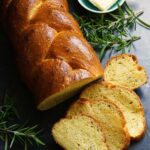
Braided Herb Bread
A deliciously soft no-knead yeasted bread made with a dough enriched with butter, eggs, and milk and flavoured with rosemary and chives or your favourite herbs. Wonderful as a side to soups and salads, meats and cheeses. Or just spread with butter for a savoury snack.
It's recommended that you read the accompanying blog post before starting. For best results, use digital scales and metric measurements as these were used to test the recipe.
Ingredients
- 500 g white bread flour (plus extra for dusting)
- 1 - 2 tbsp finely chopped herbs (e.g. rosemary, chives: see Recipe Notes)
- 2 tsp instant dry yeast (i.e. the type that can be added to the rest of the ingredients without activating first)
- 1.5 tsp salt
- 2 large eggs (beaten)
- 100 g butter (melted)
- 200 ml whole cow's milk (approx.)
For the glaze
- 1 small egg, beaten (You won't need it all. Milk can be substituted although the finish will not be as glossy)
Instructions
The day before baking
-
In a large bowl, stir together the flour, chopped herbs, instant dry yeast, and salt.
Make a well in the centre then pour in the beaten eggs and the melted butter.
Stir to start bringing the mixture together, gradually adding only enough milk to create a wettish but still firm dough. Stir well to thoroughly combine the ingredients, making sure there's no bits of dry flour: see image in the blog post for how the dough should look.
Tip: as the size of eggs varies, and different flours absorb different amounts of liquid, you may not need all the milk or you may need a splash more.
-
Cover the bowl or place in a large reusable polythene bag and leave to ferment for 12-14 hours at room temperature.
Tip: If you want to slow fermentation down (e.g. if the room is warm or it's more convenient) do the fermentation in the fridge or leave at room temperature for a few hours then put in the fridge overnight.
On the day of baking
-
The dough should have risen and spread out but is unlikely to have doubled: this is normal. However, underneath you should see small bubbles (see image in blog post): if not, leave for longer. If it's been in the fridge, allow to come to room temperature before proceeding.
-
Very lightly flour a clean work surface, ideally covered with a silicone mat to reduce sticking, and turn the dough onto it. Divide the dough into 3 equal pieces, using digital scales for accuracy.
Lightly knead each piece into a ball, then roll into strands 30 - 32 centimetres long, making them as even and smooth as possible.
Tip: if the strands shrink back as you roll, leave them to relax a little then try again.
-
Braid/Plait the strands
Place the strands vertically side by side (but not touching) then pinch firmly together at the top.
Bring the left-hand strand over the middle one so it is now in the middle. Now bring the right-hand strand over so it is in the middle.
Continue this crossing over, moving the strands to the middle in turn, keeping them tight together, until you reach the end. Pinch the bottom ends together firmly.
Tip: tuck and pinch the ends underneath the loaf for a neater look.
-
Carefully lift the loaf and place it on a greased or lined baking tray (greasing the tray before lining with paper will stop the paper moving around).
Cover or place in a large reusable polyethene bag and leave in a warm place to prove for approximately 30 - 45 minutes or until when a finger is gently poked into the dough, it slowly springs back but leaves a slight indentation. If the dough springs back quickly then it's not yet fully proofed: leave it another 5-10 minutes and check again.
Tip: complete the next step while the dough is proving.
-
While the dough is proving: preheat the oven to 220° C /200° Fan /Gas 7 /425°F with a shelf in the middle and a metal roasting tin on the bottom shelf (this will be filled with water later to create steam and help the bread rise: DO NOT USE A GLASS DISH as it could shatter when the cold water hits the hot glass).
-
When the dough is ready to bake, brush all over with beaten egg.
-
Put in the oven on the middle shelf and pour cold water from a jug into the hot metal roasting tin in the lower part of the oven then close the door.
IMMEDIATELY reduce the oven temperature to 200° C /180° Fan /Gas 6 /400° F.
Leave to bake (without opening the oven door and letting the steam out) for 20 minutes.
-
After 20 minutes:
- carefully open the oven door (caution: there may be a lot of very hot steam so keep your face, hands etc. out of the way) and remove the tin of water.
- take the tray with the bread out of the oven, but put the bread back in, directly on the middle shelf this time.
Optional: brush on another layer of beaten egg before returning to the oven.
Cook for another 10 - 12 minutes OR until the bread is dark golden brown and sounds hollow when tapped underneath.
-
Transfer to a wire rack to cool before cutting into.
Best eaten within 2 days or can be frozen.
Tip: slice or cut into chunks before freezing so you can take out as much as you need without waste.
Recipe Notes
Herbs. Almost any fresh herbs can be used, singly or in combination, e.g. oregano, basil, rosemary, chives, thyme. If using all strongly flavoured herbs such as rosemary and oregano, you may wish to use 1 tbsp rather than 2. My preference is for 1 tbsp each of chopped rosemary and chives. Dried herbs are not recommended for this recipe.