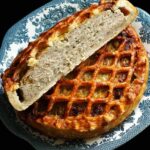
Sausage & Onion Lattice Pie
Sausage & Onion Lattice Pie is a delicious savoury cold pie, perfect for picnics, buffets, and lunch boxes.
The shortcrust pastry base is filled with a mix of chopped onion gently cooked in butter to bring out its sweetness, pork sausage meat and sage.
Finished with a lattice pastry top this surprisingly easy pie always looks impressive. But it will still taste incredibly good if you prefer a plain pastry top.
You'll need a round baking tin approximately 20 cm diameter and 4 - 5 cm deep, lined with baking paper. If making lattice top, I recommend this cutter (affiliate link).
For the best results, please use scales, metric measurements and read the accompanying blog post before starting.
Ingredients
For the shortcrust pastry
- 300 g plain/all-purpose white flour (plus extra for rolling out)
- ½ tsp salt
- 75 g cold butter, diced
- 75 g cold lard, diced (can be replaced with more butter)
- 3 - 4 tbsp iced water
- 1 small egg, beaten
For the filling
- 1 tbsp oil (e.g. light olive oil, sunflower)
- 20 g butter
- 500 g onion, roughly chopped (weight after preparation)
- 4 large cloves garlic (finely chopped)
- salt (to taste)
- black and/or white pepper (to taste)
- 650 g pork sausage meat (minimum 72% pork content: see Recipe Notes)
- 2 rounded tsp dried sage
Instructions
Make the pastry
-
Using a food processor
Put the flour and salt into the machine and briefly process to combine.
Put the diced butter and lard into the machine and process until the mixture looks like very fine breadcrumbs.
With the motor running add iced water, 1 tbsp at a time, until the mixture comes together into a smooth ball.
Making by hand
In a medium sized bowl, stir together the flour and salt.
Stir in the butter and lard then use your fingertips to rub the fat into the flour until the mixture resembles fine breadcrumbs.
Add 2 tbsp of iced water and stir in with a round bladed knife. Continue adding tablespoons of water and stirring until the mixture starts coming together.
Use your hands to bring together into a smooth ball.
-
Weigh the dough and divide it into ⅔ for the base and ⅓ for the top. e.g. if the dough weighs 500 grams, use approximately 335 g for the base and 165 g for the top.
Flatten each piece into a disc then wrap in foil or cling film and chill in the fridge for at least 30 minutes.
Tip: pastry can be chilled for longer if more convenient.
Make the filling
-
Put the oil and butter in a large frying pan over medium-low heat.
When hot, stir in the chopped onion and garlic seasoned with a large pinch of salt and a generous amount of pepper.
Cook gently, stirring now and then, until soft and golden (20 - 25 minutes).
Take the pan off the heat and set aside until cool.
-
Put the sausage meat in a bowl and add the cold onions (including any juices from the pan), the dried sage plus ½ tsp of pepper.
Start mixing everything together with a fork, then switch to your hands to thoroughly combine.
-
Important: test a piece of filling.
Break off a small piece and shape into a patty or ball.
Cook in a microwave for approximately 20 - 25 seconds or until hot and completely cooked through. Leave to cool. Taste and add more salt, pepper or sage to the sausage and onion mixture if you think it needs it.
Tip: if you don't have a microwave, fry the test piece over low heat. However, frying caramelizes the outside which makes it taste different from meat cooked in a pie.
Put the filling in the fridge until ready to assemble the pie.
Assemble the pie
-
Line your baking tin with baking paper with enough to come above the sides so you can lift the pie out.
-
Lightly dust flour over your work surface (ideally, cover it with a silicone mat first to reduce sticking and the need for extra flour) and put the piece of dough for the base on it. Flatten and sprinkle lightly with flour.
Roll out 3 - 4 mm thick into a circle big enough to come all the way up and just above the sides of the baking tin.
Lower into the tin and gently press onto the base and sides, expelling any air trapped underneath. If you have a lot of excess pastry above the rim, trim away with scissors.
-
Take the filling from the fridge and spoon it into the pie base, spreading and smoothing it down firmly.
-
Dust your work surface again and roll out the pastry for the top.
For a lattice top roll slightly smaller than the diameter of the pie.
For a plain top roll the same diameter as the pie.
Tips for using a lattice pastry cutter
° Cut on a glass board or similar so you don't damage your work surface.
° Sprinkle flour over the cutting surface and the cutter blades.
° To make sure you cut right through the pastry, press down as hard as you can and move forward slowly.
° Start cutting slightly in from one side of the pastry: you can use this space to press down with your hand to stop the pastry curling up into the blades.
-
For a lattice top carefully stretch out the latticed pastry to open out the holes. Place on top of the pie, snipping off any excess, then fold the edges of the base up and over to enclose the lattice. Press down and pinch all around to create a wavy edge.
For a plain top Flatten the top edge of the base, brush over a little beaten egg then put on the lid and press down. Now go all the way around, pinching with your fingers to seal and create a wavy edge.
Tip: if the pastry has become warm while assembling the pie, put in the fridge for 30 minutes before baking so the pastry is less likely to shrink.
Baking the pie
-
Preheat your oven to 200° C /180° Fan /Gas 6 /400° F with a shallow but lipped baking tray on the middle shelf.
-
Brush the top of the pie with beaten egg. If you've put on a full lid rather than a lattice, make 2 holes in the top with a skewer, cocktail stick or similar to allow steam to escape.
-
Put the pie on the preheated tray in the oven and bake for 30 minutes.
After 30 minutes reduce the temperature to 180° C /160° Fan /Gas 4 /350° F.
Take out the pie, brush on another layer of beaten egg, and return to the oven.
Bake for another 60 - 90 minutes or until the pastry is deep golden brown on top. The perimeter should be pulling away from the sides of the tin and look cooked too.
Tip 1: If the pastry is browning too quickly, reduce the temperature and/or loosely cover with foil.
Tip 2: If you have a thermometer, pork needs to reach at least 71° C (160° F).
-
When the pie is cooked, remove from the oven and put the tin on a cooling rack for 45 minutes to set the pastry and juices.
After 45 minutes, carefully lift out of the tin by holding the paper and put directly on the cooling rack. Take off the paper when cool enough to handle. When almost cold transfer to the fridge.
Leave until completely cold before slicing.
-
Stored in the fridge in an airtight container, the pie should keep 3 - 5 days (depending on use by dates of ingredients).
Can be frozen and defrosted in the fridge, although the pastry may not be as crisp.
Recipe Notes
Pork Sausage Meat.
- If you can't find sausage meat, remove the casings from sausages and break up the meat.
- Whichever you use, check that it has a pork content of at least 72 per cent. The results will not be as good with a lower content. Note that some popular brands of pork sausage contain just 42 per cent which is the legal minimum requirement for them to be labelled 'pork'.
- Sausage or sausage meat with a higher content than 72 per cent may give a firmer filling to the pie.