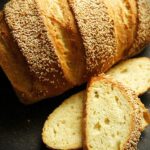
Sicilian Semolina Bread (pane di semola rimacinata)
A flavoursome, beautifully golden-coloured loaf with a chewy crumb and crispy, sesame-topped crust. Made with double-milled semolina flour the bread is associated with Sicily.
In this version it's made using an overnight, no-knead method and baked in a lidded pot: to make as a same-day kneaded bread and/or baking it on a tray instead of in a lidded pot see Recipe Notes 3 and 4 below.
Please read the accompanying blog post before starting the recipe and use digital scales and metric measurements.
Ingredients
- 450 g double-milled semolina flour (see Recipe Note 1) + extra for dusting
- 150 g strong white bread flour (can be replaced with more semolina flour: see Recipe Note 2)
- 2 tsp salt
- 1.5 tsp (7g) instant dried yeast (i.e. the sort that doesn't need activating before adding to the rest of the ingredients)
- 1 tbsp + 1tsp olive oil
- 350-400 ml/g (approx.) water (does NOT need to be warm)
For the topping
- 1 small egg, beaten (you will not need it all)
- 2-3 tbsp sesame seeds
Instructions
The night before baking
-
Put the semolina flour, and strong bread flour if using, into a large mixing bowl along with the salt and instant yeast. Stir to combine.
Make a well in the middle and add 1 tbsp of the olive oil.
Add approximately 250 ml of water to the olive oil and stir to start bringing the ingredients together. Add more water, a little at a time, until a dough has formed: you may not need all the water or you may need a little more. There should be no dry flour visible, but the dough should be firm and not sloppy.
Add 1 tsp of olive oil to the bowl and turn the dough in it so it's coated.
Cover the dough or place the whole thing in a large reusable polythene bag and leave to ferment at room temperature overnight.
Tip: If the room is warm you can do the fermentation in the fridge or leave at room temperature for a few hours then put in the fridge overnight.
On the day of baking
-
The dough should have risen, spread out and be bubbly underneath. If not, leave a little longer. If it's been in the fridge, allow to come to room temperature before proceeding.
-
Dust a little semolina flour over your work surface, ideally covered with a silicone mat, and transfer the dough onto it. Fold over itself several times until smooth: add more semolina flour if needed to prevent sticking, but try to use as little as possible.
-
Sprinkle semolina flour inside a lined banneton (or an improvised proving vessel such as a bowl lined with a tea towel).
Fold the dough again, this time shaping it to fit your proving vessel. Sprinkle the top with more semolina then put it in the vessel with the rounded side facing DOWN. Dust the side now facing up with a little semolina.
Place in a large reusable polythene bag or cover it and leave in a warm place for approximately 30 - 45 minutes.
While it's proving: preheat your oven to 240°C / 220° Fan / Gas 9 / 475° F and put a lidded cast iron pot or Dutch oven on the middle shelf.
-
Check if the dough is ready to bake: gently insert a finger into the dough and see if the dough quickly or slowly springs back.
- If the dough springs back slowly and leaves an impression, it's ready.
- If it springs back immediately and doesn't leave an impression then prove another 5 - 10 minutes and check again.
-
When ready to bake, remove the pot from the oven and take off the lid.
Carefully flip the dough into the pot so the rounded side is now facing UP.
Brush beaten egg all over the top of the dough then sprinkle thickly with sesame seeds.
Use a sharp knife, razor blade or baker's lame to make three slashes across the width of the dough (or make your own preferred pattern).
Put the lid on the pot, place in the oven and bake for 35 minutes.
-
After 35 minutes, reduce the heat to 220° C / 200° Fan / Gas 7 / 425°F.
Remove the pot from the oven, tip the bread out of it, then return the loaf to sit directly on the oven shelf.
Bake for a further 5 - 8 minutes or until the bread is cooked through: it should sound hollow when tapped underneath.
-
Place on a wire rack until completely cold before slicing.
Best eaten within 3 days or can be frozen.
Tip: slice before freezing so you can take out as much as you need without waste.
Recipe Notes
Note 1: Semolina Flour. For this recipe you will need semolina flour that has been double- or re-milled so that it is finer than regular semolina. Look out for products labelled semola remacinata ('remilled semolina') in Italian. Recommended (paid links): 1kg bags here or buy in bulk to save money 6 x 1kg bags here.
Note 2: 100% vs 75% semolina bread. Incorporating some strong white bread flour into the dough gives a slightly more risen result than using all semolina flour. Other differences are described in the accompanying blog post.
Note 3: Same day, kneaded version. Follow the recipe except use lukewarm water (no more than 38 degrees C) to make the dough and use less of it. You may wish to add a teaspoon of sugar (or honey which is sometimes used in this loaf) to help feed the yeast during the shorter fermentation. The dough should not have any dry flour visible but it should not be too wet or you won't be able to knead it. Knead for 8 - 10 minutes, or until smooth and elastic, before leaving to ferment in a warm place for 1 - 2 hours or almost doubled in size. Proceed with the recipe.
Note 4: Baking on a tray instead of a covered pot.
- Make the dough following the overnight no-knead method as per the recipe card or as a same-day kneaded version as Note 3 above.
- During the second rise or prove, preheat the oven to 200°C / 180°C Fan / Gas 6 /400°F with a shelf in the middle and a deep roasting tin [DO NOT USE GLASS AS IT COULD SHATTER] on the bottom shelf: later, this will be filled with cold water to create steam and help the bread rise.
- Dust a shallow baking tray with flour and tip the proved dough onto it. Add the egg and sesame topping, slash, then put in the oven on the middle shelf. Immediately pour cold water into the tin on the bottom shelf and close the door. Bake for 30 minutes.
- After 30 minutes carefully open the oven door (caution: lots of hot steam may billow out so keep your face, hands etc. out of the way) and remove the tin of water.
- Take the tray with the bread out of the oven then place the bread back in, this time directly on the middle shelf.
- Bake for another 8 - 10 minutes or until the bottom of the loaf sounds hollow when tapped.