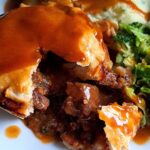
Venison, Mushroom and Bacon Pies
Individual pies with slow-cooked venison in a rich gravy (plus extra to serve with them) are incredibly delicious. Lovely with mashed potato or chips and veg.
Split the work by cooking the pie filling the day before so it has time to completely cool. Make the shortcrust pastry in the morning, chill it, then form the pies.
Ingredients
For the pie filling
- 500 g stewing venison, cut into large bite-sized pieces (can be replaced with stewing beef)
- salt
- black pepper
- 2 tbsp oil (e.g. light olive, sunflower)
- 120 g smoked streaky bacon, lardons or pancetta (roughly chopped)
- 1 large onion (skinned, roughly chopped)
- 2 stalks celery (finely chopped)
- 6 large cloves garlic (skinned, finely chopped)
- 1 rounded tsp dried thyme (optional)
- 50 g plain/all-purpose flour
- 500 - 1000 ml beef stock (see Recipe Notes for more info)
- 1 tbsp Worcestershire sauce or Balsamic vinegar (optional)
- 10 g butter
- 250 g mushrooms (cut into chunky pieces)
- 2 tbsp finely chopped parsley
For the pastry
- 400 g plain/all-purpose flour (plus extra for dusting)
- ¾ tsp salt
- 100 g cold butter (diced) plus extra for greasing
- 100 g cold lard (diced: can be replaced with more butter)
- 4 - 6 tbsp iced water
For the glaze
- 1 small - medium egg (beaten)
Instructions
Make the pie filling
-
Preheat your oven to 140° C / 120° Fan /Gas 1 /275° F.
Season the venison with salt and pepper then set aside.
-
Put the oil in a large ovenproof casserole dish (it will need a lid later) and put over medium-high heat.
When hot, add the chopped bacon, lardons or pancetta and cook until the fat is golden. Use a slotted spoon to remove to a large plate, leaving the fat in the casserole dish.
-
In batches, brown the seasoned venison in the casserole: don't crowd the pot or it will steam rather than brown. As each batch is done, transfer it to the plate with the bacon. Continue until all the venison is browned.
-
Reduce the heat to medium/medium-low then add the prepared onion, celery and garlic. Add a little salt, a good grind of pepper plus the dried thyme then stir around, scraping up any browned bits from the bottom of the casserole.
Cook for 8 - 10 minutes or until the vegetables are starting to soften and colour.
-
Add the plain/all-purpose flour and stir constantly for 2 minutes.
Take the casserole temporarily off the heat and gradually add approximately 250 ml of the stock, stirring constantly until smooth with no lumps of flour.
Stir in the remaining stock then put back on the heat.
Keep stirring until the gravy bubbles and thickens.
Add the Worcestershire sauce, taste and season with a little more salt and pepper.
-
Add the browned bacon and venison to the casserole, including any juices that have collected on the plate. Stir and bring back up to a simmer.
-
Put a lid on the casserole and transfer to the preheated oven. Cook until the venison is very tender: approximately 2 - 2 ½ hours.
Note: while this is happening complete the next step.
-
Put the 10 g of butter in a frying pan over medium heat.
When melted add the prepared mushrooms and season with a little salt and pepper. Cook for a few minutes, stirring regularly, until the mushrooms are lightly coloured and starting to soften.
When the venison is just tender stir the mushrooms and any pan juices into the casserole dish. Return to the oven for a further 15 - 20 minutes.
-
Use a slotted spoon to remove the pieces of venison, mushrooms, and bacon to a lidded container. Pour the remaining filling through a sieve and into a jug.
Transfer the contents of the sieve into the container with the venison and bacon. Stir in the chopped parsley along with all but 500 ml of the gravy in the jug.
-
Leave the filling and the extra gravy to cool then transfer to the fridge until completely cold.
Tip: once cold, can be stored for 24 hours or frozen.
Make the shortcrust pastry dough
-
Using a food processor
Put the flour and salt into the machine and briefly process to combine.
Put the diced butter and lard into the machine and process until the mixture looks like very fine breadcrumbs.
With the motor running add iced water, 1 tbsp at a time, until the mixture comes together into a smooth ball.
Making by hand
In a medium sized bowl, stir together the flour and salt.
Coarsely grate in the butter and lard: dip into the flour now and then to prevent sticking. Using your fingertips, rub the fat into the flour until the mixture resembles fine breadcrumbs.
Add 3 tbsp of cold water and stir in with a round bladed knife. Continue adding tablespoons of water and stirring until the mixture starts coming together.
Use your hands to bring together into a smooth ball.
-
Wrap in foil or cling film and chill in the fridge for at least 30 minutes.
Tip: if preferred, divide the dough as per the next step, then chill.
Tip: pastry can be chilled for longer (or frozen) if more convenient.
Divide the pastry dough
-
Using digital scales for accuracy divide the dough into 6 pieces for the pie bases and 6 smaller ones for the lids. Roll into smooth balls.
Example: my pie tins (affiliate link) have a diameter of approximately 10 cm across the top, 7.5 cm at the base, and a height of 3.5 cm. I divided the dough into roughly 80 g pieces for the bases and 30 g pieces for the lids.
Alternative: roll out all the dough and stamp out rounds with suitably sized cutters. Re-roll the scraps.
Line the tins
-
Grease the tins with butter: melting and brushing it on is easiest.
-
Lightly dust flour over your work surface (ideally, cover it with a silicone mat first to reduce sticking and the need to add extra flour) and put one of the pieces of dough for the bases on it and flatten. Sprinkle lightly with flour and roll into a circle big enough to come all the way up the sides of a pie tin, but not so big that you need to cut any off.
Tip: for my tins I rolled the bases into approximately 13 cm circles.
Neaten the top edge by pressing down and smoothing with your fingers.
Repeat with the remaining dough for the bases.
Roll out the smaller pieces of dough into circles to fit on top then set aside.
Fill the pies
-
Divide the filling between the pie bases so it comes up to the top.
Brush some of the beaten egg around the top edge of the pastry then put on a pastry lid: gently press down to expel any air trapped underneath, then firmly press all around to stick it to the base.
Go all around pinching the edge between two fingers to seal.
Repeat with the remaining pies.
Tip: pies can be stored in the fridge until ready to bake or baked straight away.
Bake the pies
-
Preheat your oven to 180° C /160° Fan /Gas 4 /350° F with a shallow baking tray on the middle shelf.
-
Brush the tops of the pies with the remaining beaten egg.
Make 2 holes in the top of each one with a skewer, cocktail stick or similar to allow steam to escape.
-
Transfer to the oven and bake for approximately 35 minutes or until the pastry is crisp golden brown and the filling is hot and just starting to bubble a little through the steam vents.
Tip 1. If your oven cooks unevenly, turn the tray around after the first 20 minutes.
Tip 2. After 20 minutes you can add another layer of beaten egg for a deeper glaze.
-
When the pies are done, remove from the oven but leave for 5 minutes before carefully removing from their tins and serving with the reserved gravy heated in a saucepan on top of the stove.
Cooled pies can be stored in the fridge (in their tins) for 24 hours or frozen.
Reheating
-
Preheat oven to 180° C /160° Fan /Gas 4 /350° F.
Put the pies on a baking tray and cover with foil.
Bake until the filling is piping hot: approximately 30 minutes from chilled, 50 minutes from frozen. Remove the foil for the final 5 - 10 minutes to re-crisp the pastry if necessary.
Recipe Notes
Stock. The recipe assumes you'll want to make extra gravy to serve with the pies. If not, you can reduce the stock to 500 - 750 ml. If you don't make extra gravy then you don't need to separate at step 9 of making the pie filling: just transfer it to a container to cool.