Sausage & Onion Lattice Pie
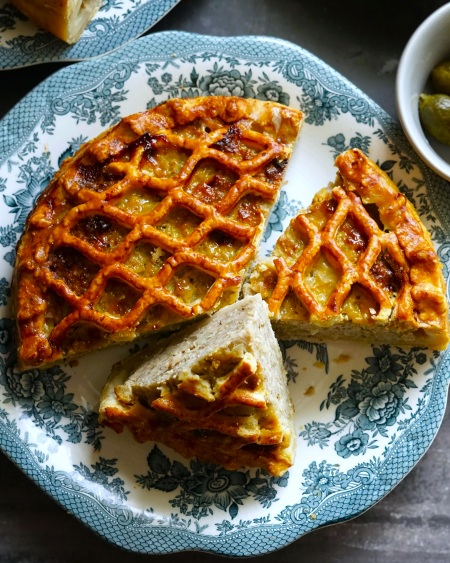
Sausage & Onion Lattice Pie is a delicious savoury cold pie, perfect for picnics, buffets, and lunch boxes. The shortcrust pastry base is filled with a mix of chopped onion gently cooked in butter to bring out its sweetness, pork sausage meat and sage. Finished with a lattice pastry top this surprisingly easy pie looks impressive. But it will still taste incredibly good if you prefer a plain pastry top.
Jump to Recipe
Disclosure: this post may contain affiliate links.
My Sausage & Onion Lattice Pie is in the great British tradition of cold meat pies. Most famously, there’s the pork pie. the very best of which, Melton Mowbray pork pies, come from my old home county of Leicestershire. It’s thought that the pastry case on the original pork pies was simply a way of making it easily transportable by agricultural workers. And the hearty cold meat pie recipe I’m sharing today is equally good as a portable feast.
Perfect for picnics and lunch boxes, I think my Sausage & Onion Lattice Pie will also look impressive on your buffet table. The great news though is that it really isn’t difficult. The hands-on time needed for this thoroughly delicious pie is surprisingly small too. But you’ll be rewarded with the deep, savoury flavour of sausage and sage blended with the sweetness that comes from slow-cooked onions, encased in a rich shortcrust pastry, topped with a pretty lattice.
SAUSAGE & ONION LATTICE PIE: ORIGINS
The idea for this wonderful pie stems from my childhood. With a big family and not a great deal of money, large pork pies were something for special occasions like Christmas tea or wedding buffets. More often, we’d have a sausage and onion cold pie. Also produced by one of the big manufacturers of pork pies, the lattice-topped pie was made with sausage meat rather than cuts of pork so was more affordable.
Being considerably flatter and wider, it could also easily be cut into more portions. What I especially loved was its sweetish flavour from cooked onions combined with a distinct herby pepperiness.
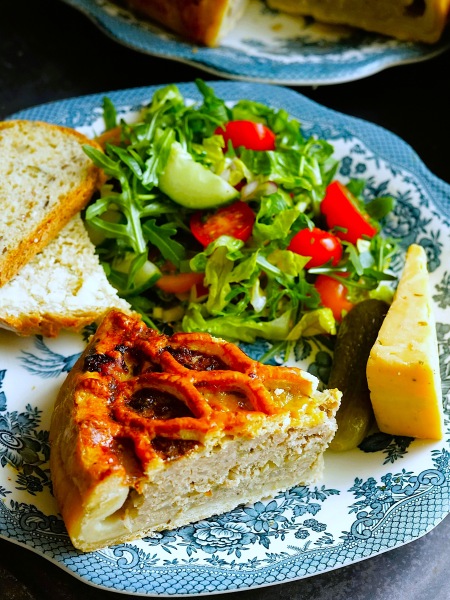
I’ve been unable to find when this particular pie stopped being made. I think the last time I ate it was the 1990s. Anyway, being a great lover of homemade pies, I thought it wouldn’t be too difficult to make my own version. Happily, it turned out great first time and everyone who’s tried it loves my Sausage & Onion Lattice Pie.
HOW TO MAKE SAUSAGE & ONION LATTICE PIE
You’ll find ingredient amounts and full instructions in the recipe card at the end. But I recommend you read the whole of this post first for extra tips and step-by-step images to guide you.
EQUIPMENT
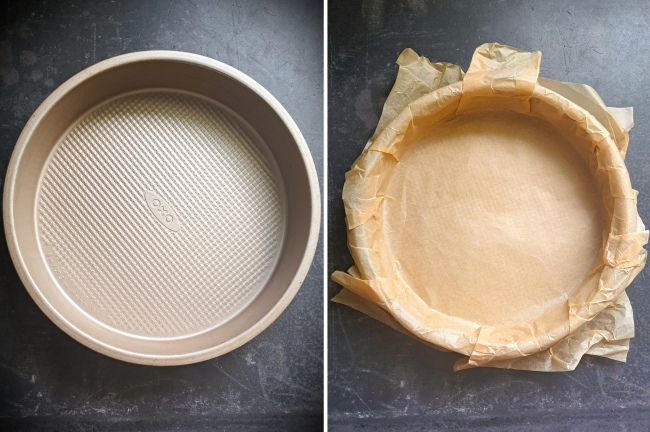
Besides the usual kitchen paraphernalia of bowls, knives, rolling pin etc. you’ll need a 20 cm round baking tin, 4 – 5 cm deep. Line it with baking paper so you can easily remove the Sausage & Onion Lattice Pie.
Two other items I recommend, although you can certainly make the recipe without them, are:
- Silicone mat. Useful for lots of baking jobs, covering your work surface with one of these reduces sticking so you need less flour when rolling out the pastry. They also make cleaning up easier.
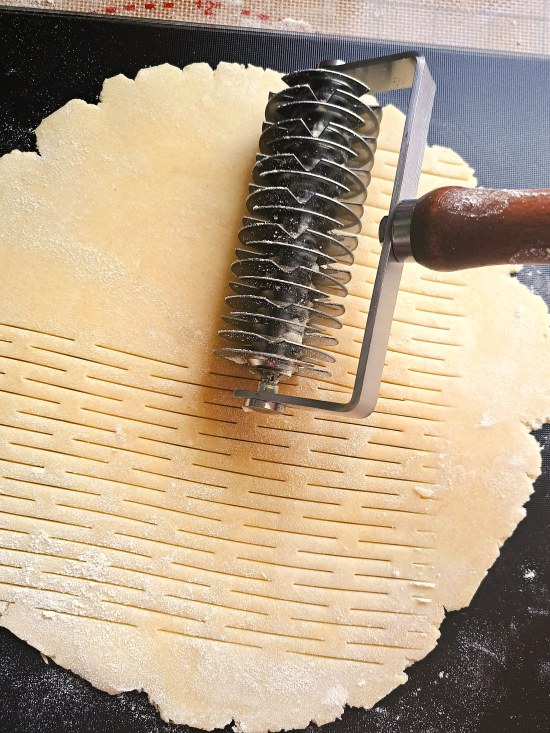
- Lattice pastry cutter. Gives you a perfect lattice top in next to no time. The alternative is to cut thin strips of pastry and weave a lattice yourself or just add a plain pastry lid.
INGREDIENTS
For a crisp shortcrust pastry with good flavour, I use equal amounts of butter and lard. You could replace the lard with butter if preferred. Plain/all-purpose flour, salt, and iced water are the other pastry ingredients, plus beaten egg to give it a shiny glaze.
For the filling you’ll need:
- Pork sausage meat (or sausages with skins removed). Check that it has a pork content of at least 72 per cent; some popular brands contain just 42 per cent which is the legal minimum. You’ll need 650 grams to make the pie which serves at least 8.
- Onions. Crucial to the flavour profile, you’ll need roughly 500 grams of chopped onion.
- Garlic. The pie doesn’t have a noticeable garlicky taste, but a little does enhance the savoury flavour.
- Oil and butter. Used to slowly cook the onion and garlic.
- Salt, pepper, dried sage. Simple seasonings but the result is delicious.
MAKE THE PASTRY
Pastry is easiest to roll out when chilled. So make it first then pop in the fridge while you prepare the filling. In the recipe card I’ve given instructions for making it using a food processor and by hand.
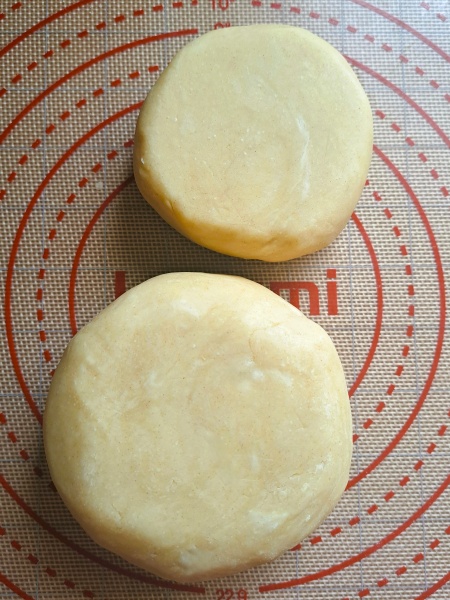
Divide the pastry into two pieces. You’ll need roughly two-thirds for the pie base and one-third for the top. Wrap in foil or cling film and chill for at least 30 minutes. The pastry can be left for longer if necessary, or even frozen.
MAKE THE FILLING
Considering how packed with flavour it is, the filling for my Sausage & Onion Lattice Pie is really easy.
All you do is heat the oil and butter and cook the chopped onion and garlic, seasoned with a little salt and pepper, until soft and golden. For the best results, don’t rush it. Allow 20 – 25 minutes, stir often, and don’t let it brown. We want the natural sugars to caramelize without darkening too much. Before combining with the sausage meat, allow it to cool.
Now put the sausage meat in a bowl, add the cooked onion and garlic, plus the dried sage and some pepper. I like a combination of white and black pepper, but you can use either. We’ll check the salt level in a moment, so don’t add any yet. You can start mixing the filling with a silicone spoon, but I find it easiest to then switch to my hands to ensure everything’s thoroughly combined.
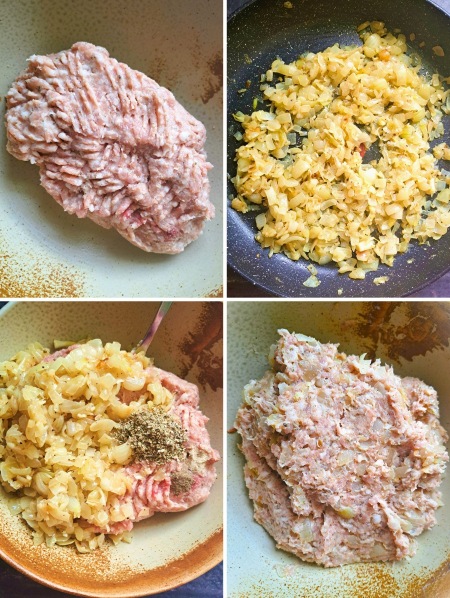
The next step is hugely important: check the seasoning of the filling. The best way to do this is to break off a piece, shape into a ball or patty and microwave it. This may seem odd, but a microwave replicates more closely the way the filling will cook in the pie. If you don’t have a microwave, you can fry the test piece, but bear in mind this will caramelize the outside so the flavour won’t be the same. Either way, leave the piece to cool, then eat it. Does the filling need any salt, more pepper or sage?
When you’re happy with the flavour, put the filling in the fridge until you’re ready to assemble the pie.
ASSEMBLING SAUSAGE & ONION LATTICE PIE
Roll your chilled shortcrust pastry approximately 3 – 4 mm thick and press into the paper-lined baking tin. It should come up just above the rim. If you have a lot of excess pastry, trim away with scissors. Now spoon the sausage and onion filling into the base, spreading and smoothing it down firmly to avoid any gaps.
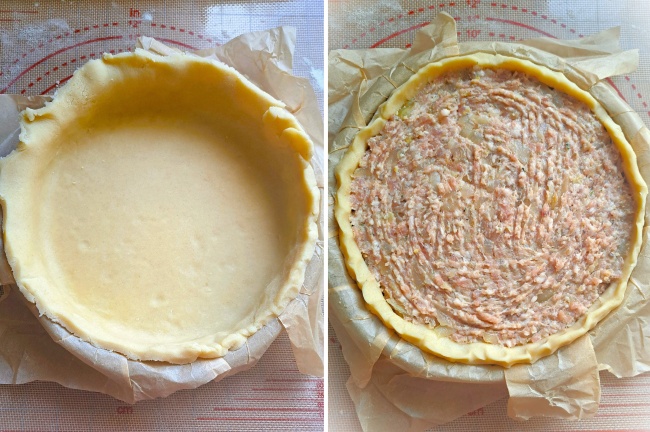
If you’re making the lattice top:
Roll the pastry for the lid slightly smaller than the diameter of the pie. It needs to fit within the perimeter of the base. If you’re using a lattice cutter for the first time, note that I’ve included tips in the recipe card to help you.
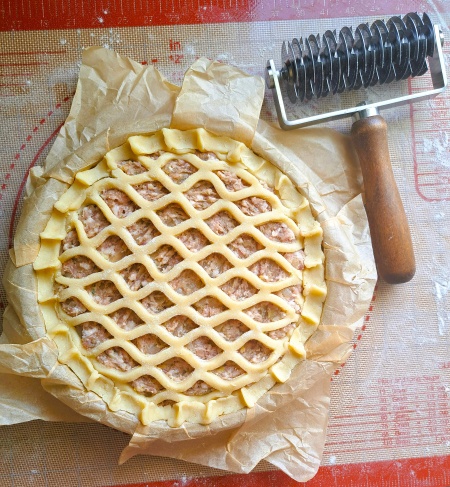
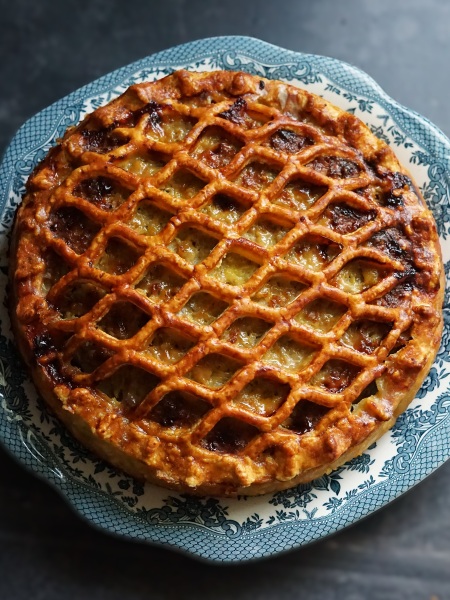
Carefully stretch out the lattice to open up the holes as much or as little as you like, then place on top of the filling. Trim away any excess. Now fold the sides of the pastry base over the edges of the lattice to neatly enclose them. Finally go all around, pinching with your fingers to seal and make a wavy pattern.
If you’re making a plain top:
You should roll the pastry for a plain top the same diameter as the pie. That’s because it needs to sit on top of the base. Flatten the top edge of the base, brush over a little beaten egg then put your lid on top and press down. Go around with your fingers, pinching to seal and make a wavy pattern.
BAKING SAUSAGE & ONION PIE
If the pastry feels a little warm by the time you’ve assembled the pie, you may want to chill it in the fridge for 30 minutes or so. This should reduce any shrinking when you bake it. Meanwhile, preheat your oven to the temperature shown in the recipe card. Have a shallow but lipped baking tray on the middle shelf to heat up too.
When ready to bake, brush a generous layer of beaten egg over the top of the pie. If you’ve made a full plain top, make a couple of holes with a skewer or cocktail stick to let the steam out. 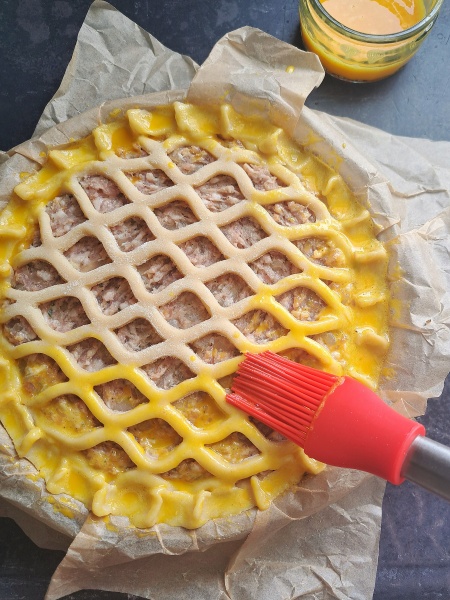
Put the pie on the preheated tray in the oven and bake for 30 minutes. After 30 minutes, reduce the temperature as per the recipe card and brush on another layer of beaten egg.
Return to the oven and bake the Sausage & Onion Lattice Pie for another 60 – 90 minutes or until the pastry is deep golden brown on top. The sides should be pulling away from the sides of the tin and look cooked too. If the top’s browning too quickly you can either reduce the oven temperature a little or loosely cover with a piece of foil. If you have a thermometer, check that the pork sausage has reached at least 71° C (160° F).
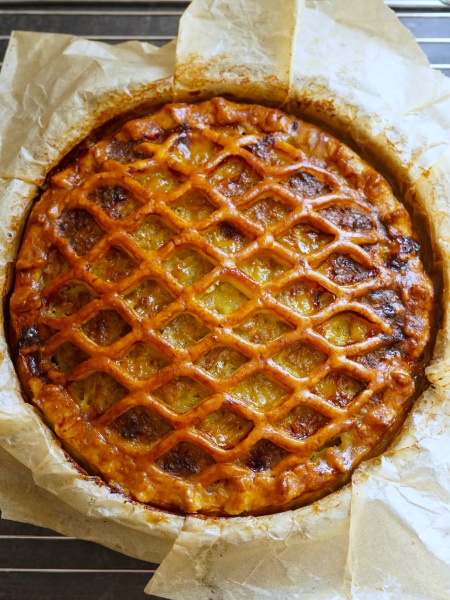
When the pie’s done, put the tin on a wire cooling rack to let the pastry and juices set before attempting to take it out. After 30 – 45 minutes it should be firm enough to lift out using the paper and put directly on the rack. Carefully take it off the paper when you can, put in the fridge when just warm and leave until completely cold before serving.
DELICIOUS SAVOURY COLD SAUSAGE & ONION LATTICE PIE
Cutting into the pie for the first time, I was excited but a little apprehensive too. Would it live up to those childhood memories of a deliciously savoury and herby cold sausage pie with sweetness from buttery cooked onions? I’m happy to say, it did! Making the pie is pretty straightforward too. The hardest part was working out how much of each ingredient to use. And I’ve now done that for you!
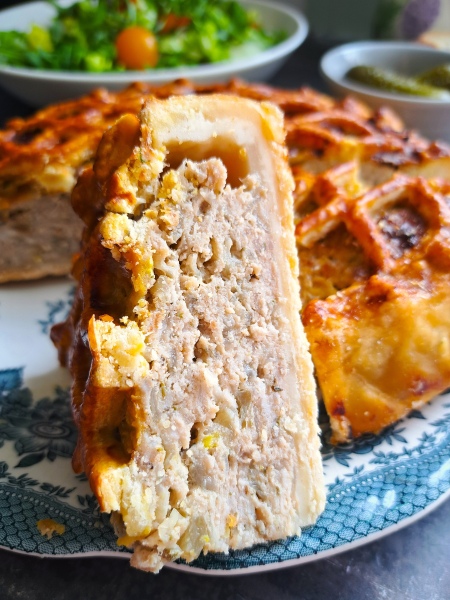
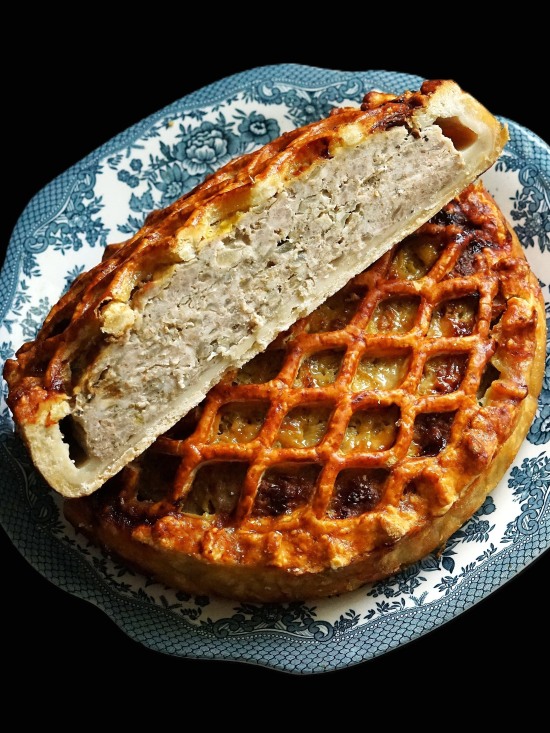
I like that the filling, being sausage meat plus lots of onion rather than pure pork, is softer than a traditional pork pie. Add to that the hint of sage and I think it’s a real stunner. I also love the way the pastry absorbs lots of meaty flavour. Just like a pork pie, the side facing the filling takes on an almost creamy texture.
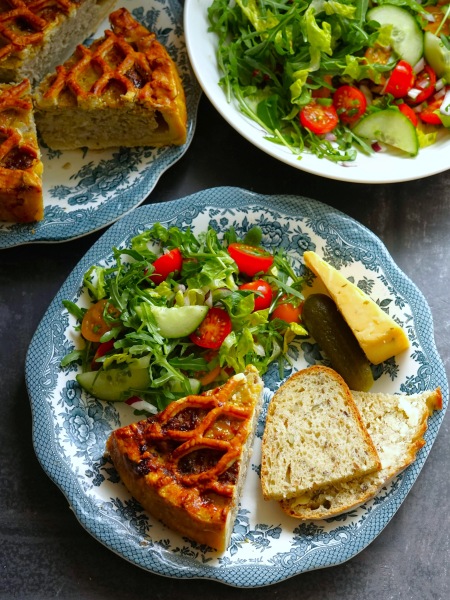
With a lattice top, I think the pie looks stunning. But it’s still one hundred per cent worth making if you can only manage a plain pastry top. Serve it with salad, as part of a buffet, picnic, or a ploughman’s lunch and everyone is sure to be impressed.
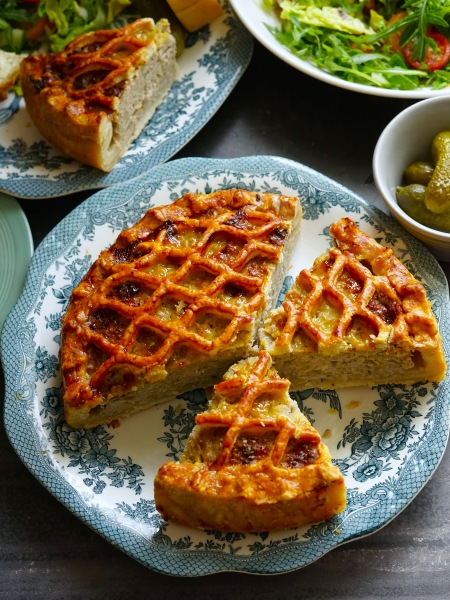
Stored in an airtight container, Sausage & Onion Lattice Pie should keep for 3 – 5 days. Which makes it perfect for packed lunches and snacks too.
If you’ve made this recipe, I’d love to know what you thought. Please do leave a comment and rating.


Sausage & Onion Lattice Pie
Sausage & Onion Lattice Pie is a delicious savoury cold pie, perfect for picnics, buffets, and lunch boxes.
The shortcrust pastry base is filled with a mix of chopped onion gently cooked in butter to bring out its sweetness, pork sausage meat and sage.
Finished with a lattice pastry top this surprisingly easy pie always looks impressive. But it will still taste incredibly good if you prefer a plain pastry top.
You'll need a round baking tin approximately 20 cm diameter and 4 - 5 cm deep, lined with baking paper. If making lattice top, I recommend this cutter (affiliate link).
For the best results, please use scales, metric measurements and read the accompanying blog post before starting.
Ingredients
For the shortcrust pastry
- 300 g plain/all-purpose white flour (plus extra for rolling out)
- ½ tsp salt
- 75 g cold butter, diced
- 75 g cold lard, diced (can be replaced with more butter)
- 3 - 4 tbsp iced water
- 1 small egg, beaten
For the filling
- 1 tbsp oil (e.g. light olive oil, sunflower)
- 20 g butter
- 500 g onion, roughly chopped (weight after preparation)
- 4 large cloves garlic (finely chopped)
- salt (to taste)
- black and/or white pepper (to taste)
- 650 g pork sausage meat (minimum 72% pork content: see Recipe Notes)
- 2 rounded tsp dried sage
Instructions
Make the pastry
-
Using a food processor
Put the flour and salt into the machine and briefly process to combine.
Put the diced butter and lard into the machine and process until the mixture looks like very fine breadcrumbs.
With the motor running add iced water, 1 tbsp at a time, until the mixture comes together into a smooth ball.
Making by hand
In a medium sized bowl, stir together the flour and salt.
Stir in the butter and lard then use your fingertips to rub the fat into the flour until the mixture resembles fine breadcrumbs.
Add 2 tbsp of iced water and stir in with a round bladed knife. Continue adding tablespoons of water and stirring until the mixture starts coming together.
Use your hands to bring together into a smooth ball.
-
Weigh the dough and divide it into ⅔ for the base and ⅓ for the top. e.g. if the dough weighs 500 grams, use approximately 335 g for the base and 165 g for the top.
Flatten each piece into a disc then wrap in foil or cling film and chill in the fridge for at least 30 minutes.
Tip: pastry can be chilled for longer if more convenient.
Make the filling
-
Put the oil and butter in a large frying pan over medium-low heat.
When hot, stir in the chopped onion and garlic seasoned with a large pinch of salt and a generous amount of pepper.
Cook gently, stirring now and then, until soft and golden (20 - 25 minutes).
Take the pan off the heat and set aside until cool.
-
Put the sausage meat in a bowl and add the cold onions (including any juices from the pan), the dried sage plus ½ tsp of pepper.
Start mixing everything together with a fork, then switch to your hands to thoroughly combine.
-
Important: test a piece of filling.
Break off a small piece and shape into a patty or ball.
Cook in a microwave for approximately 20 - 25 seconds or until hot and completely cooked through. Leave to cool. Taste and add more salt, pepper or sage to the sausage and onion mixture if you think it needs it.
Tip: if you don't have a microwave, fry the test piece over low heat. However, frying caramelizes the outside which makes it taste different from meat cooked in a pie.
Put the filling in the fridge until ready to assemble the pie.
Assemble the pie
-
Line your baking tin with baking paper with enough to come above the sides so you can lift the pie out.
-
Lightly dust flour over your work surface (ideally, cover it with a silicone mat first to reduce sticking and the need for extra flour) and put the piece of dough for the base on it. Flatten and sprinkle lightly with flour.
Roll out 3 - 4 mm thick into a circle big enough to come all the way up and just above the sides of the baking tin.
Lower into the tin and gently press onto the base and sides, expelling any air trapped underneath. If you have a lot of excess pastry above the rim, trim away with scissors.
-
Take the filling from the fridge and spoon it into the pie base, spreading and smoothing it down firmly.
-
Dust your work surface again and roll out the pastry for the top.
For a lattice top roll slightly smaller than the diameter of the pie.
For a plain top roll the same diameter as the pie.
Tips for using a lattice pastry cutter
° Cut on a glass board or similar so you don't damage your work surface.
° Sprinkle flour over the cutting surface and the cutter blades.
° To make sure you cut right through the pastry, press down as hard as you can and move forward slowly.
° Start cutting slightly in from one side of the pastry: you can use this space to press down with your hand to stop the pastry curling up into the blades.
-
For a lattice top carefully stretch out the latticed pastry to open out the holes. Place on top of the pie, snipping off any excess, then fold the edges of the base up and over to enclose the lattice. Press down and pinch all around to create a wavy edge.
For a plain top Flatten the top edge of the base, brush over a little beaten egg then put on the lid and press down. Now go all the way around, pinching with your fingers to seal and create a wavy edge.
Tip: if the pastry has become warm while assembling the pie, put in the fridge for 30 minutes before baking so the pastry is less likely to shrink.
Baking the pie
-
Preheat your oven to 200° C /180° Fan /Gas 6 /400° F with a shallow but lipped baking tray on the middle shelf.
-
Brush the top of the pie with beaten egg. If you've put on a full lid rather than a lattice, make 2 holes in the top with a skewer, cocktail stick or similar to allow steam to escape.
-
Put the pie on the preheated tray in the oven and bake for 30 minutes.
After 30 minutes reduce the temperature to 180° C /160° Fan /Gas 4 /350° F.
Take out the pie, brush on another layer of beaten egg, and return to the oven.
Bake for another 60 - 90 minutes or until the pastry is deep golden brown on top. The perimeter should be pulling away from the sides of the tin and look cooked too.
Tip 1: If the pastry is browning too quickly, reduce the temperature and/or loosely cover with foil.
Tip 2: If you have a thermometer, pork needs to reach at least 71° C (160° F).
-
When the pie is cooked, remove from the oven and put the tin on a cooling rack for 45 minutes to set the pastry and juices.
After 45 minutes, carefully lift out of the tin by holding the paper and put directly on the cooling rack. Take off the paper when cool enough to handle. When almost cold transfer to the fridge.
Leave until completely cold before slicing.
-
Stored in the fridge in an airtight container, the pie should keep 3 - 5 days (depending on use by dates of ingredients).
Can be frozen and defrosted in the fridge, although the pastry may not be as crisp.
Recipe Notes
Pork Sausage Meat.
- If you can't find sausage meat, remove the casings from sausages and break up the meat.
- Whichever you use, check that it has a pork content of at least 72 per cent. The results will not be as good with a lower content. Note that some popular brands of pork sausage contain just 42 per cent which is the legal minimum requirement for them to be labelled 'pork'.
- Sausage or sausage meat with a higher content than 72 per cent may give a firmer filling to the pie.
RELATED RECIPES