
Potato, Cheese and Onion Plate Pie
Potato, Cheese and Onion Plate Pie is budget-friendly and so tasty. Made with a classic combination of simple, everyday ingredients, enjoy it as an economical dinner with veg or salad, chips or coleslaw and baked beans. Just as good cold for packed lunches and picnics too.

Disclosure: this post may contain affiliate links. If you buy via my links, I may earn a small commission at no extra cost to you.
Jump to Recipe
I always find making a pie so satisfying. Although how anyone first came up with the idea of mixing fat and flour then baking it to create the wonder that is crisp, crumbly pastry I don’t know. Add to that the infinite number of delicious pie fillings it’s possible to dream up, and I think everyone should try their hand at a homemade pie.

But perhaps inexperienced cooks think it’s too difficult or requires a lot of time, effort, and ingredients? In this post I’ll show you it doesn’t have to be that way. With a handful of everyday, inexpensive ingredients and without masses of hands-on time, you really can create a wonderfully tasty Potato, Cheese and Onion Plate Pie.
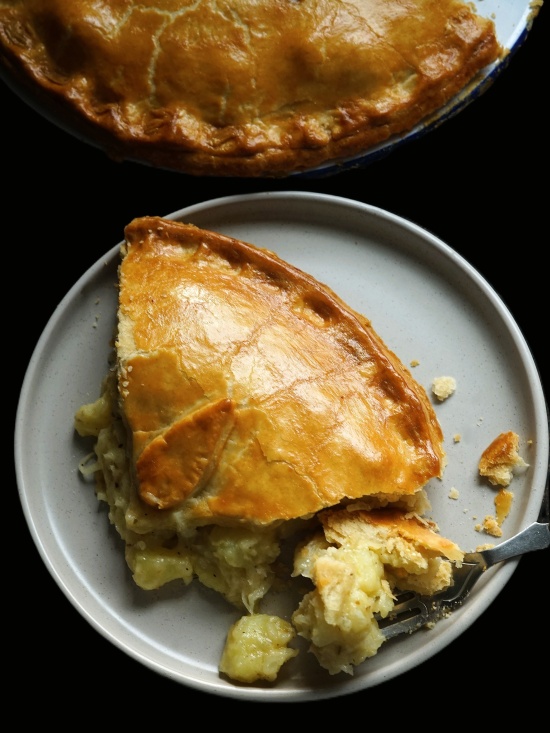
WHAT IS A PLATE PIE?
Plate pies are a British tradition particularly associated with the Midlands and north of England. They’re hearty, filling food, double-crusted with a pastry bottom as well as lid.
They’re often baked on enamel pie plates (affiliate link). The enamel is a good conductor of heat, helping to create a crisp base. Most familiar are the white enamel plates with a dark blue rim originally made in the 1920s in the Black Country near Birmingham. But any baking plate or shallow dish with a diameter in the region of 22 – 24 centimetres is fine.
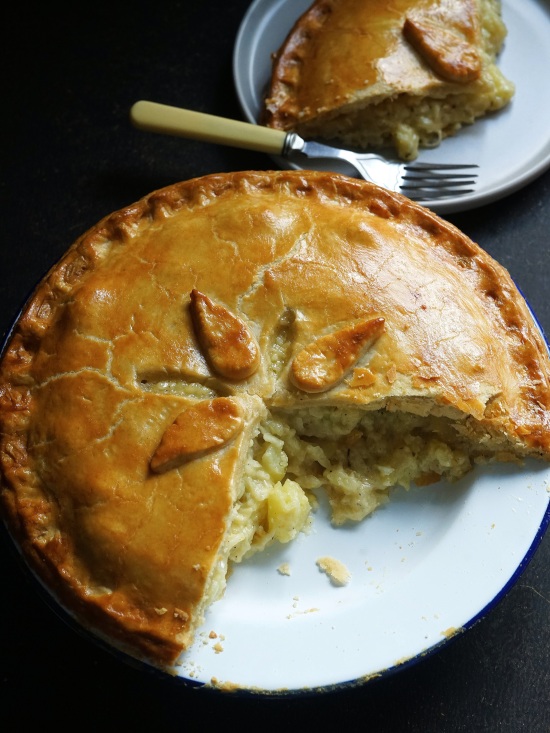
Plate pies can be a thrifty option as, being shallow, you don’t need as much filling as a deeper pie. The fillings themselves also tend towards the economical and homely. Well-loved favourites include corned beef or meat and potato where spuds stretch the meat further. A great favourite of mine is wonderfully savoury Sausage Plate Pie. But perhaps the simplest of all is Potato, Cheese and Onion Plate Pie.
POTATO, CHEESE AND ONION PLATE PIE
Based on three simple everyday ingredients I always have in the house, Potato, Cheese and Onion Plate Pie is a great standby when you want something hearty and filling but fuss-free, economical, as well as tasty.
At its most pared back, the filling is just boiled potatoes, grated cheese such as mature Cheddar, onion, salt and pepper. This is the version you’ll find here, plus a little dried thyme. At the end, I give a few suggestions for how you can vary the filling.

HOW TO MAKE POTATO, CHEESE AND ONION PLATE PIE
You’ll find ingredient amounts and full instructions in the recipe card at the end. But I recommend you read the whole of this post first for extra tips plus step-by-step images to help you. For the best results you should use digital scales (affiliate link) and metric measurements as these were used to test the recipe
EASY HOMEMADE SHORTCRUST PASTRY
I always make my plate pies with shortcrust pastry. Given their humble origins, I think this is most fitting, as well as being simpler than puff or flaky pastry. Even if you don’t have a food processor (affiliate link) shortcrust is still easy. In the recipe card at the end, you’ll find instructions for making in a machine and by hand.
All you need are plain flour, salt, butter, and water. I’ve gone the traditional (and cheaper) route by replacing half the butter with lard. I find this gives the perfect balance between crispness and flavour.
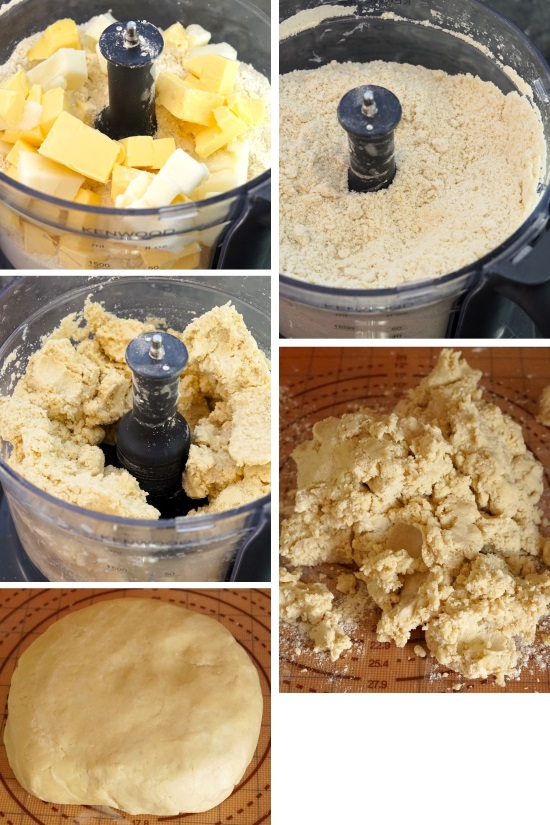
I also use a small beaten egg to seal the pie as well as giving it an attractive shiny glaze. You can replace the egg with milk if you prefer, although the glaze won’t be as glossy.
After you’ve made the pastry, it will need chilling in the fridge to make rolling out easier. Thirty minutes is usually long enough. But it won’t come to any harm if it’s more convenient to make the pastry further in advance. Before chilling, I divide the pastry into two pieces, roughly 60 percent for the base and 40 percent for the lid.
MAKE THE FILLING
While the pastry is chilling, you make the filling.
Potatoes. Simmer chopped potatoes in salted water until only just tender. Small to medium sized chunks are best so they don’t take long to cook nor soften too quickly. When done, drain and leave to cool. You can chop them a bit smaller at this stage if you like.
Onions. As the onion goes into the pie raw (unless you do one of the possible variations at the end of this post), it should be finely chopped or grated. If like me you have a mandoline slicer (affiliate link) then a super-fast trick is to first slice thinly using the mandoline. Then it’s just a few seconds chopping with your knife to reduce it to tiny pieces.
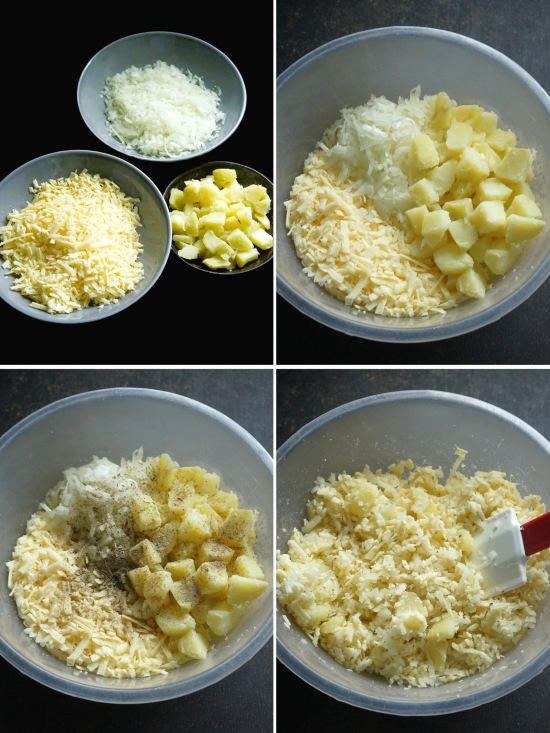
Cheese. Coarsely grate your mature Cheddar.
Stir these three ingredients together in a bowl. Season with a good grind of black pepper plus the dried thyme if using. Add a pinch of salt, bearing in mind that cheese can be quite salty, and you already salted the potatoes. Taste and add more seasoning if it needs it.
Like the pastry, the filling can be kept in the fridge until later if that’s more convenient for you.
ASSEMBLING THE PIE
When you’re ready to assemble the pie, lightly flour your work surface, ideally covered with a silicone mat (affiliate link) to prevent sticking. Roll out the larger piece of pastry into a circle that will come just over the edge of your pie plate, taking account of any dip in the middle.
Place the pastry on the pie plate and gently press down. Holding up in one hand, go around the edge with a knife to trim away excess pastry. Now roll out the smaller piece of pastry for the lid, a little bigger than your pie plate, and set aside. If you’ve time, chill the cut-out pastry again. This helps reduce shrinkage during cooking. But if your pastry is still cool from its first chilling then there’s no need.
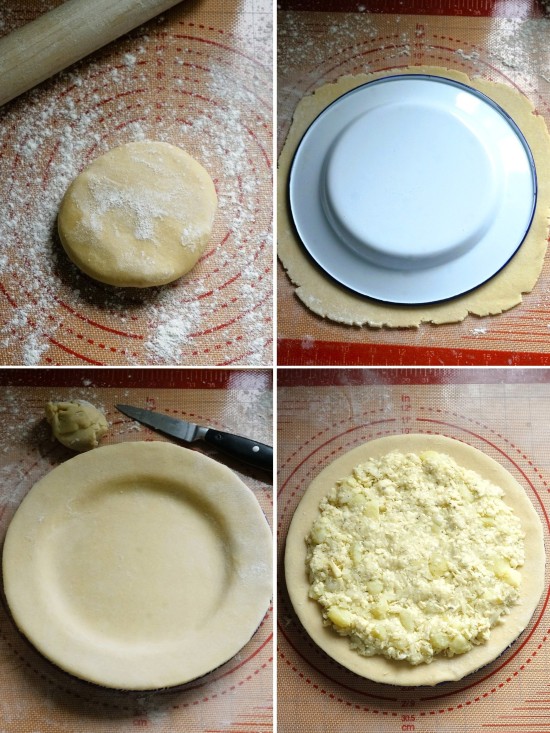
Now pile the filling onto the pastry-lined plate and spread evenly, leaving a border approximately 2 cm all around. Use your hands to press down and firm the filling to reduce the likelihood of gaps.
Brush the border with some of the beaten egg (or milk). Place the pastry lid on top, pressing down to expel any air trapped underneath, then firmly press all around the border to stick it to the base. Cut off any excess pastry. Now go around pinching the edge between two fingers to create a wavy pattern. Or just press down with a fork so you have little lines all around.
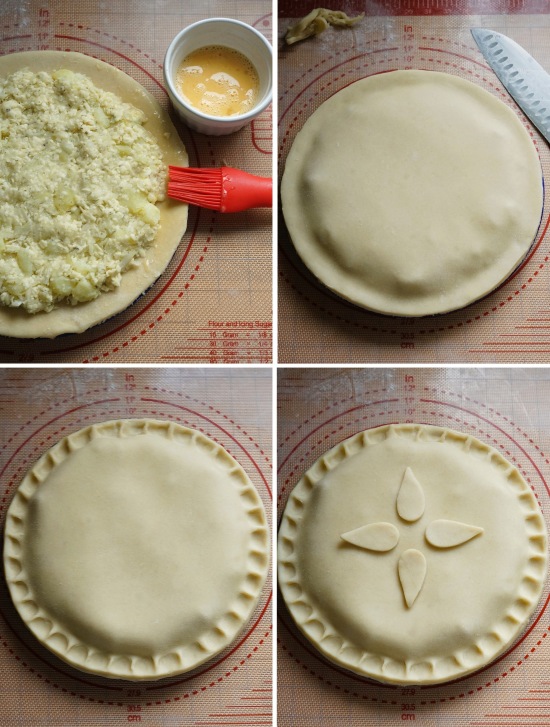
Instead of wasting the pastry trimmings, I gather and re-roll them to decorate the top. I stamp out leaves, stars or other shapes, sticking them on with some of the beaten egg. If you don’t want to cook the pie yet, chill it in the fridge.
BAKING POTATO, CHEESE AND ONION PLATE PIE
Your oven should be preheated to the temperature shown in the recipe card. Have a shelf in the middle position and put a baking tray on it to preheat too. This will help quickly crisp the bottom of the pie as well as prevent any juices leaking into your oven.
When you’re ready to bake, brush a layer of beaten egg (or milk) all over the pie. Then cut a few slits in the pastry to allow steam to escape as it cooks.
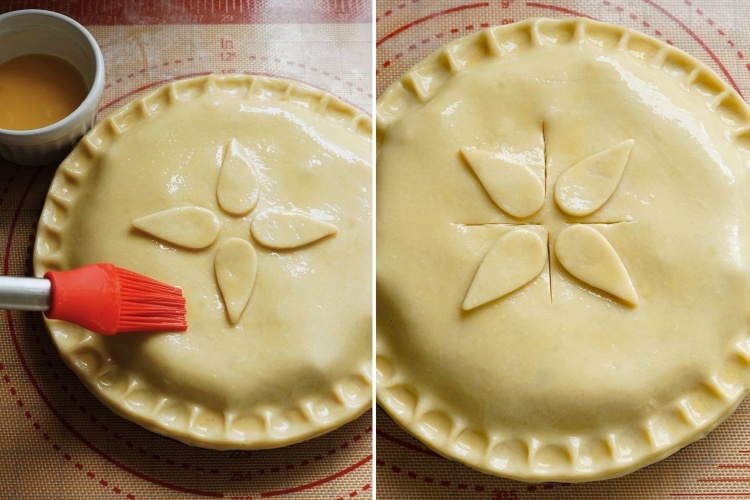
Put the Potato, Cheese and Onion Plate Pie on the preheated tray in the oven where it should take approximately 35 minutes to bake to a crisp golden brown. The filling should be hot and just bubbling a little through the steam vents. Because my oven cooks unevenly, at the 20-minute mark I turn the pie around. I also take the opportunity to add another layer of beaten egg for a deeper glaze.
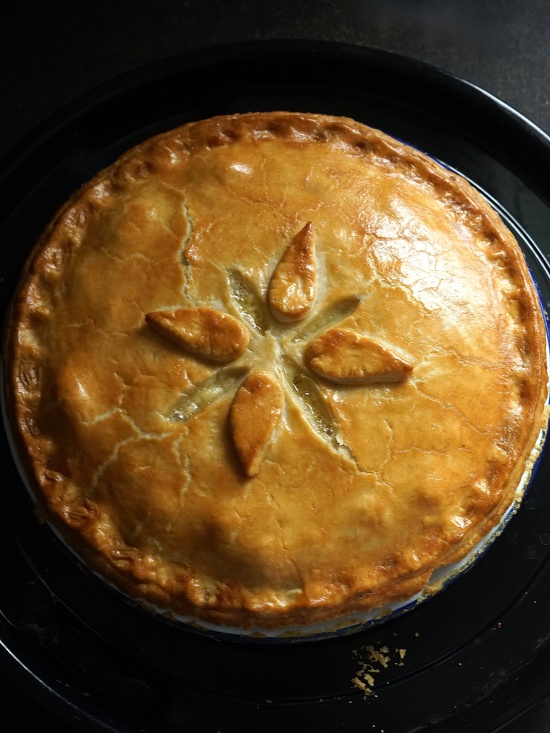
When it’s done, remove from the oven but leave for five minutes before slicing. This gives the pastry a chance to firm a little.
SERVING, STORING & VARIATIONS
My favourite thing to eat with full-flavoured, tangy Potato, Cheese and Onion Plate Pie is baked beans and homemade coleslaw. If you’re feeding a particularly hungry bunch then you could add a few homemade oven chips too. On the lighter side, you could just serve with cooked vegetables or a big, dressed salad.
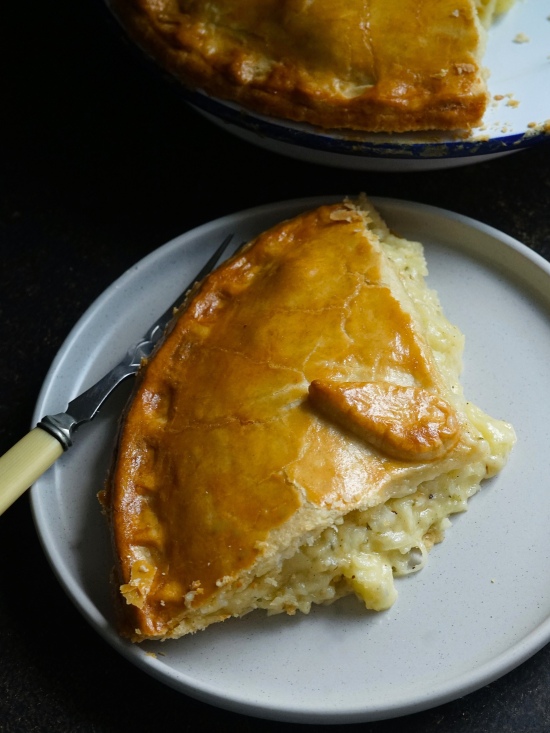
With a household of two, we usually eat half hot for dinner and the rest for lunches the next day. You can either reheat the pie or eat it cold. While the texture is quite different cold (firm rather than soft and melting), I really like it that way too. Which makes Potato, Cheese and Onion Plate Pie great for packed lunches and picnics. It will be fine in the fridge for three days or you can freeze.
If you want to reheat, it can be done in a low oven. But my quicker preference is to microwave until hot then put in a medium oven or the air fryer to re-crisp the pastry.
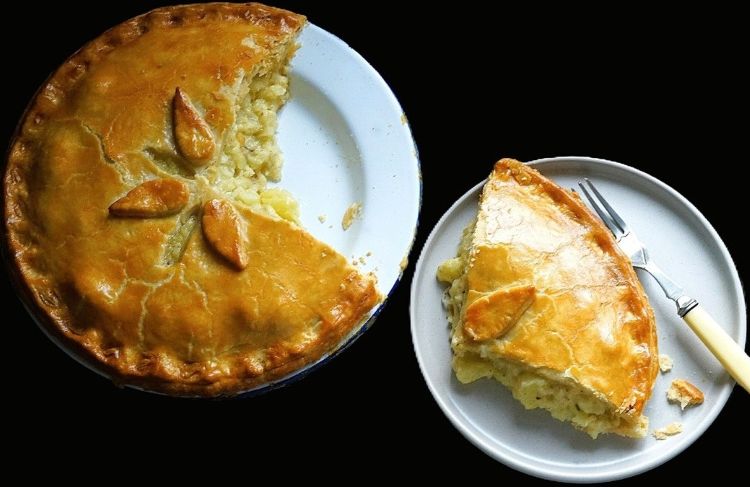
VARIATIONS
I’ve given you my very simplest version of Potato, Cheese and Onion Plate Pie, but there’s lots of ways to adapt it. Here’s just a few.
- More economical/less fat. My version is exceptionally cheesy, but you could reduce the cheese by 50 grams and increase the amount of potato.
- Lighter onion taste. For a more subtle onion flavour, instead of raw onion you can lightly boil it (drain well before adding the other ingredients) or sauté in oil and/or butter.
- Herbs and spices. Swap the dried thyme for other flavourings e.g. English mustard powder, wholegrain mustard, smoked paprika, fresh snipped chives.
- Cheese pastry. Make it extra cheesy by adding 25 g finely grated Parmesan to the pastry mix.
If you’ve made this recipe, I’d love to know what you thought. Please do leave a comment and rating.


Potato, Cheese and Onion Plate Pie
Budget-friendly, easy, and so tasty. With a classic combination of simple, everyday ingredients, enjoy this pie as an economical dinner with veg or salad, chips or coleslaw and baked beans. Great cold for packed lunches and picnics too.
You will need an oven safe round pie plate approximately 22 - 23 cm in diameter.
It's recommended that you read the accompanying blog post before starting the recipe. Use digital scales and metric measurements as these were used to test the recipe.
Ingredients
For the shortcrust pastry
- 250 g plain/all-purpose flour (plus extra for dusting)
- 1 large pinch salt
- 125 g cold butter (recommended: replace half with lard)
- 3 - 4 tbsp iced water
For the filling
- 250 g potatoes (weight after peeling or leave unpeeled if preferred)
- salt (to taste)
- 1 large onion
- 200 g mature Cheddar cheese (coarsely grated)
- 1 tsp dried thyme (optional: see blog post for alternatives)
- black pepper (to taste)
For sealing and glazing
- 1 small egg, beaten (can be replaced with milk)
Instructions
Make the shortcrust pastry
-
Using a food processor
Put the flour and salt into the machine and briefly process to combine.
Dice the butter plus lard if using, add to the machine and process until the mixture looks like fine breadcrumbs.
With the motor running add cold water, 1 tbsp at a time, until the mixture comes together into a smooth ball.
Making by hand
In a medium sized bowl, stir together the flour and salt.
Coarsely grate in the butter plus lard if using: dip into the flour now and then to prevent sticking. Using your fingertips, rub the fat into the flour until the mixture resembles fine breadcrumbs.
Add 2 tbsp of cold water and stir in with a round bladed knife. Continue adding tablespoons of water and stirring until the mixture starts coming together.
Use your hands to bring together into a smooth ball.
-
Using digital scales, divide the pastry in two: roughly 60 per cent for the pie base and 40 percent for the lid. e.g. if the dough weighs 420g divide into 250g for the base and 170g for the lid.
Flatten each piece into a disc then wrap in foil or cling film and chill in the fridge for at least 30 minutes: this makes it easier to roll out.
Tip: pastry can be chilled for longer if more convenient.
Make the filling
-
Dice the potatoes into small - medium chunks. Put in a saucepan, more than cover with cold water and season with salt.
Bring to a boil and rapidly simmer until just tender (don't let them get too soft).
Drain and set aside until cold. Cut into smaller chunks if liked.
-
Skin the onion and chop very finely or grate it.
Tip: if you have a mandoline slicer, it's quickest to finely slice on the mandoline then chop with a knife.
-
Put the cold cooked potatoes, onions, and grated cheese into a bowl and season with the thyme if using and a generous amount of black pepper. Add a pinch of salt, bearing in mind that Cheddar cheese can be quite salty and you already added salt to the cooking potatoes.
Stir until while combined, taste and add a little more seasoning if liked.
Assemble the pie
-
On a lightly floured work surface, ideally covered with a silicone mat to reduce sticking, roll out the larger piece of pastry into a circle that will come over the edge of your pie plate: remember to take account of any dip in the middle.
Place the pastry on the pie plate and gently press down. Holding up the plate in one hand, go around the edge with a knife to trim away excess pastry.
Roll out the smaller piece of pastry a little bigger than your pie plate and set aside.
Tip: the cut-out pastry can be chilled again if you like.
-
Transfer the filling to the pastry-lined plate and spread it evenly, leaving a bare border approximately 2 cm all round.
Use your hands to press down and firm the filling to reduce the likelihood of gaps.
-
Brush some of the beaten egg (or milk) all over the border. Place the pastry lid on top, pressing down to expel any air trapped underneath, then firmly press all around to stick it to the base. Use a knife to cut off the excess pastry.
Go all around pinching the edge between two fingers to create a wavy pattern, or press around with the tines of a fork.
Use up any pastry trimmings by re-rolling and cutting out leaves, stars or other shapes. Stick to the top of the pie with some of the beaten egg (or milk).
Tip: if you don't want to cook the pie straight away, it can be chilled in the fridge.
Baking the pie
-
Preheat your oven to 200°C / 180°Fan /Gas 6 /400°F.
Position a shelf in the middle with a large baking tray on it to preheat: this will help crisp the bottom of the pie and also stop any juices leaking into your oven.
-
Brush a layer of beaten egg (or milk) all over the pie then make some slits into the pastry to allow steam to escape.
-
Transfer to the preheated tray in the oven and bake for 35 minutes or until the pastry is crisp golden brown and the filling is hot and just starting to bubble a little through the steam vents.
Tip 1. If your oven cooks unevenly, turn the pie around after the first 20 minutes.
Tip 2. After 20 minutes you can add another layer of beaten egg or milk for a deeper glaze.
-
When the pie is baked, remove from the oven but leave for 5 minutes before slicing to allow the pastry to firm a little.
Pie can be eaten hot or cold. Store in the fridge for 3 days or freeze.
Reheat in a low oven, air fryer, or microwave. Recommended: reheat in a microwave followed by a few minutes in an air fryer or medium oven to re-crisp the pastry.
RELATED RECIPES
Excellent ! I’ve been trying to make a pie like this for ages – my husband has fond memories of the one his mother made and this is the first one to match the right combination of cheese, onion and potato., according to his food memories. I finely sliced the potatoes, as I had bought a mandolin on Black Friday and wanted to use it. Really good, many thanks for the recipe.
Wishing you a Very Happy Christmas and New Year 🎄
Thank you so much for your fantastic feedback, Helen, and you’re very welcome! It’s lovely to hear my recipe meant you and your husband got the pie you were after. Happy Christmas to you too 😀.
I’m always interested in affordable recipes. Lucky you, if cheese and eggs are considered budget friendly in your country, not so in New Zealand. Sounds like a nice meal though
Yes, a quick internet search does suggest that eggs and cheese (and many other staples) are less expensive in the UK than in New Zealand. Interesting article here https://www.nzherald.co.nz/business/new-zealand-groceries-more-expensive-than-australia-uk-and-ireland-research/55CPLNLPGZDPZP73S5EQNYE6UU/
As I mention in the post, you could reduce the amount of cheese in the pie (it IS very cheesy!) and increase the potatoes if you want it to be more economical.